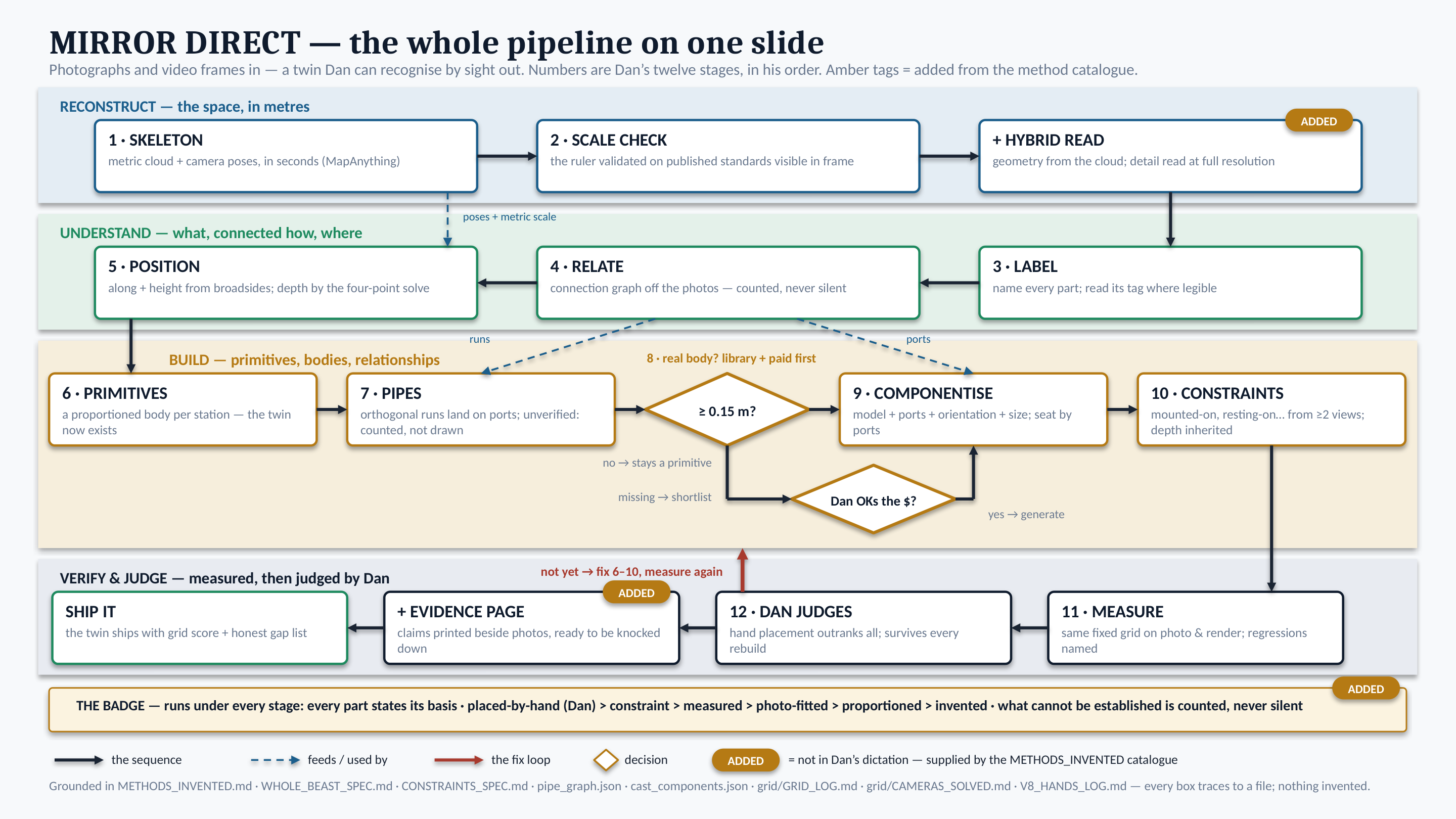
RECONSTRUCT — the space, in metres
Before anything is drawn, the photographs are turned into geometry you can trust: where the cameras stood, and how big things really are.
A metric point cloud and the camera poses, recovered from the photographs in seconds by feed-forward reconstruction. This is the backbone every later stage measures against.
The ruler is validated on published standards visible in frame — parts made to a standard have published dimensions, so they are rulers of known length lying inside the photograph. Scale never comes from a vision model's eyes.
Thin pipes ghost in a reconstruction — a 42 mm header can be four pixels there. So geometry comes from the cloud, and every small dimension is read at the photograph's full resolution, corrected by the cloud's own geometry.
UNDERSTAND — what, connected how, where
The pictures are read the way a person reads a machine room: name things, trace what joins what, and pin each thing down in space.
Every part is named; printed tags and brands are read wherever they are legible — and quoted only where they are legible.
A connection graph is traced off the photographs: which port joins which run. Runs the pictures cannot establish are counted, never silent.
Along-the-cart and height are read from level broadside views; depth comes from the four-point camera solve. The weakest axis is named as the weakest axis.
BUILD — primitives, bodies, relationships
Now the twin exists — first as honest proportioned primitives, then with real scanned bodies where they are earned, held together by relationships instead of loose coordinates.
A proportioned body per station. From this point on there is a twin to look at, criticise and measure.
Orthogonal runs drawn from the connection graph, landing on ports. Unverified runs stay counted text on screen — they are never drawn.
Two gates before a primitive is replaced: is the part big enough to matter (≥ 0.15 m), and is the cost of generating its model approved? A no on either means it honestly stays a primitive.
A model alone is a pebble — the right shape with nothing saying where the pipe attaches. A component is model + ports + orientation + size, and it is seated by its ports, not by its bounding box.
Mounted-on, resting-on, in-line-with — relationships read from at least two views. A part bolted to a post has no independent depth; it inherits the post's, so the fix cannot drift.
VERIFY & JUDGE — measured, then judged
The twin is not declared right — it is measured against the photographs, and then a person who knows the machine judges it. The person outranks the pipeline.
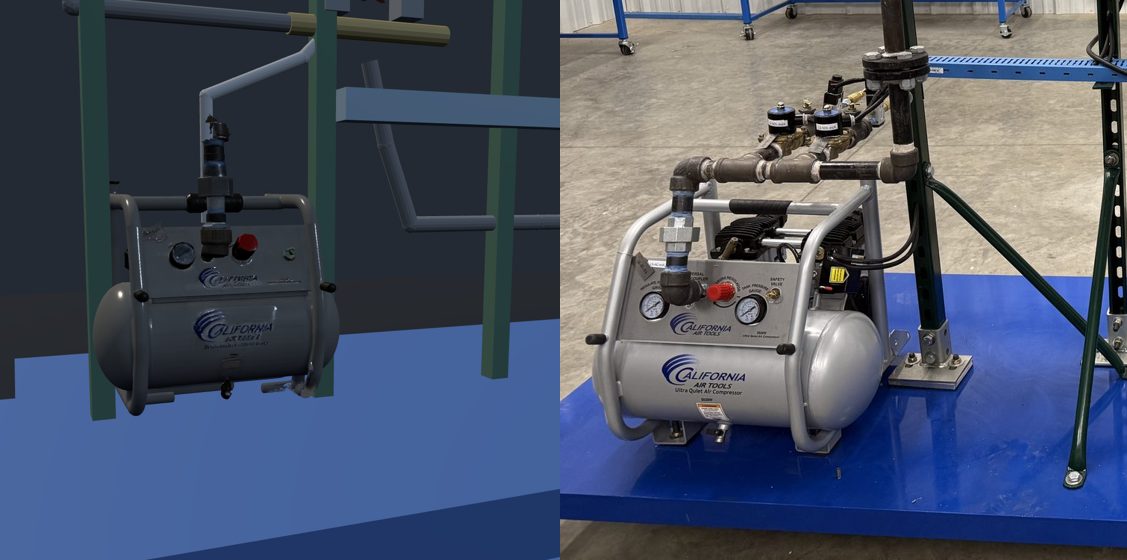
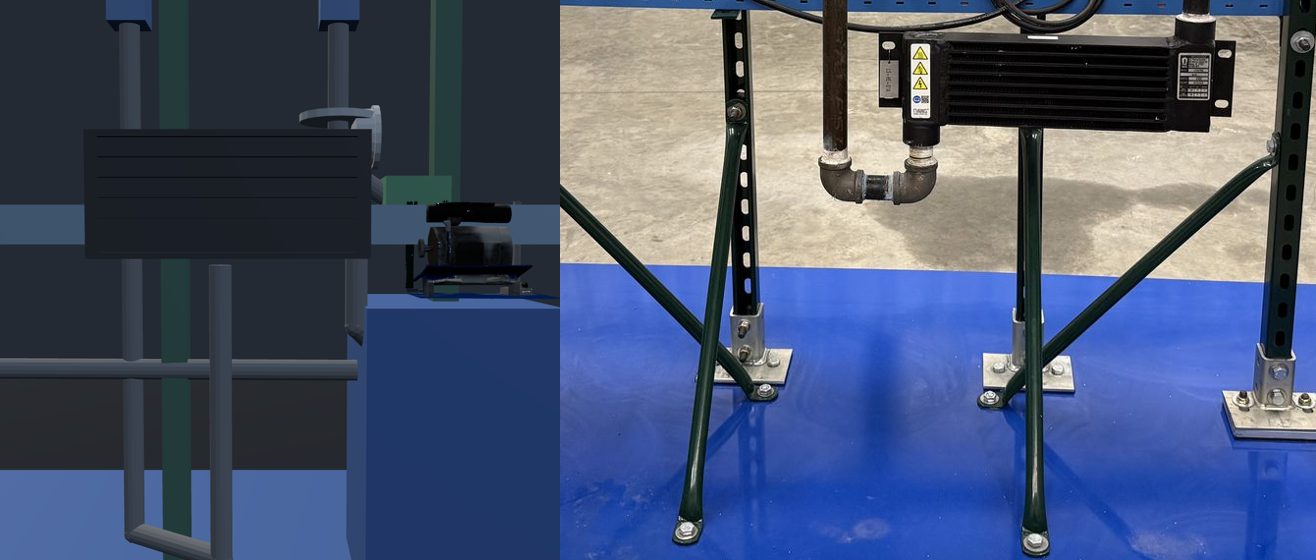
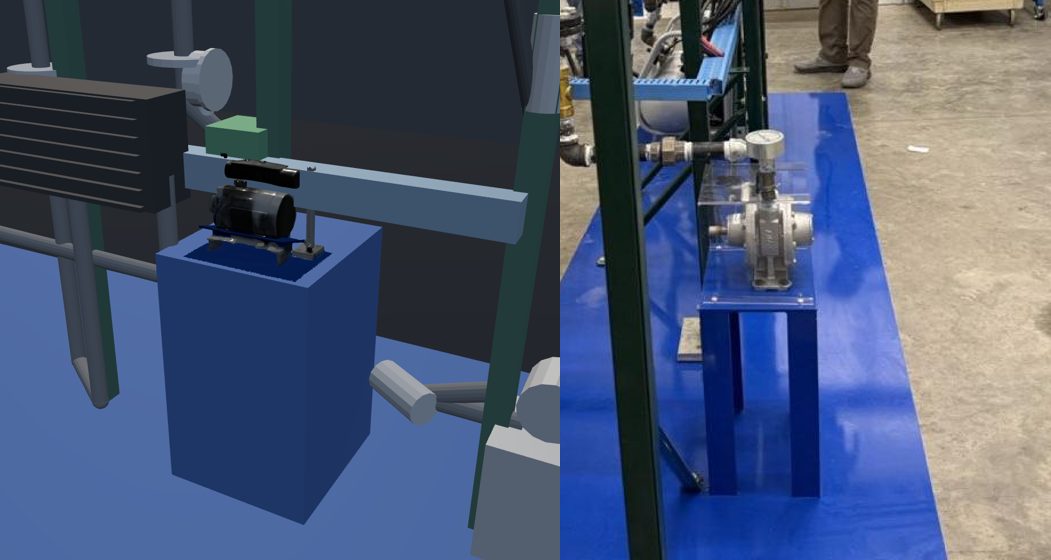
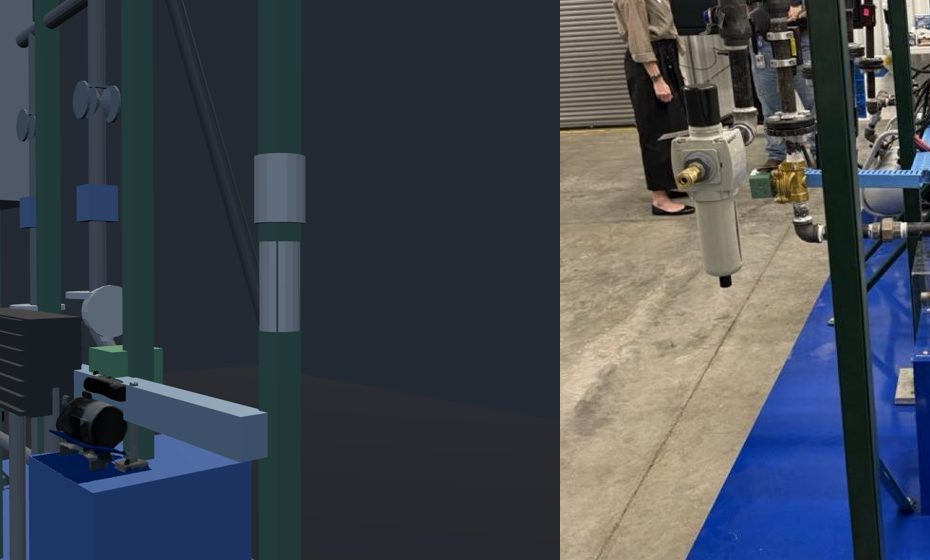
Photograph and render are cut into the same fixed grid and compared cell by cell. The score is a regression detector, never a target — its one job is to stop approved work being silently undone.
Hand placement by someone who knows the machine is the highest basis there is. It outranks every automatic estimate and survives every rebuild — no later pass may overwrite it.
Every claim is printed beside the photograph it came from, with a how-to-falsify line. The page exists so the claims can be knocked down, not admired.
The twin ships with its grid score and an honest gap list — what is measured, what is estimated, and what is missing, all stated.
The badge — the rule under every stage
Every part states its basis, and the bases have a fixed order of authority:
placed by hand > constraint > measured > photo-fitted > proportioned > invented
What cannot be established is counted, never silent: the LS twin lists its undrawn pipe runs on screen rather than inventing them. Click any part in the LS viewer and its own basis text opens — including its conflicts, where the sources disagree.
Photo beside twin — judge it yourself